Holistic Digital Transformation – from guiding Principles to Implementation
Holistic Digital Transformation – from guiding Principles to Implementation
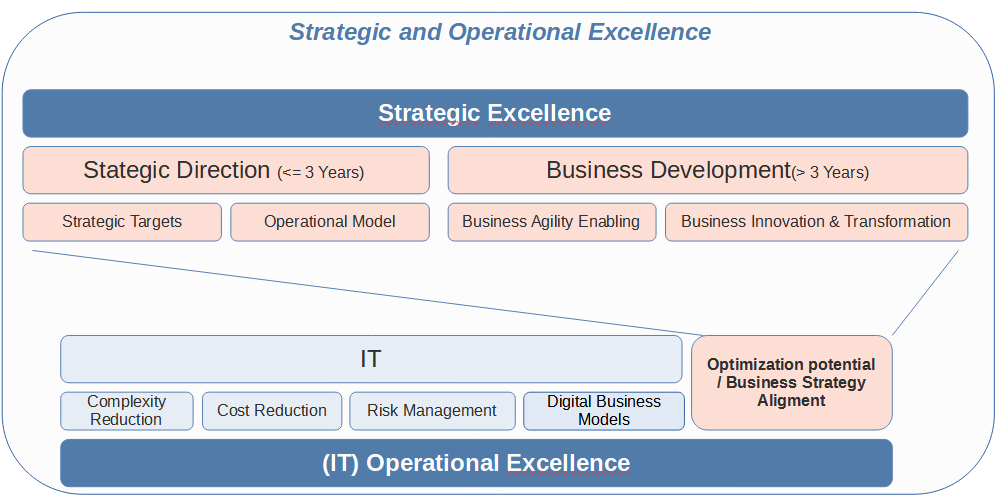
Digital Transformation is far more than the introduction of new technologies. It is a strategic change process that begins with a company's vision and mission and continues consistently through business models, organization, and processes to the targeted use of digital technologies.
IT Strategy consulting follows a holistic, top-down approach. Companies receive comprehensive support from the strategic planning stage to operational implementation – with the goal of achieving a sustainable balance between innovation and profitability without losing sight of secure and stable business operations.
Digital Transformation is far more than the introduction of new technologies. It is a strategic change process that begins with a company's vision and mission and continues consistently through business models, organization, and processes to the targeted use of digital technologies.
IT Strategy consulting follows a holistic, top-down approach. Companies receive comprehensive support from the strategic planning stage to operational implementation – with the goal of achieving a sustainable balance between innovation and profitability without losing sight of secure and stable business operations.
Strategy before Technology
Digital Transformation doesn't begin with IT systems, but with strategic thinking. Successful transformation means consistently focusing on the benefits for people – customers, employees, partners. Technology is an enabler, not a driver.
All measures, processes, and methods are derived from clearly defined strategic business objectives. Established structures serve as stable anchor points within which organizations can develop in an agile, innovative, and future-oriented manner. A key success factor of digital transformation is the balance between stability and change. Ongoing business operations must remain secure, reliable, and economical at all times – while new digital business and operating models are developed in parallel.
Strategy before Technology
Digital Transformation doesn't begin with IT systems, but with strategic thinking. Successful transformation means consistently focusing on the benefits for people – customers, employees, partners. Technology is an enabler, not a driver.
Alle Maßnahmen, Prozesse und Methoden leiten sich aus klar definierten strategischen Geschäftszielen ab. Feste Strukturen dienen als stabile Ankerpunkte, innerhalb derer sich Organisationen agil, innovativ und zukunftsorientiert weiterentwickeln können.
A key success factor of digital transformation is the balance between stability and change. Ongoing business operations must remain secure, reliable, and economical at all times – while new digital business and operating models are being developed in parallel.
Vision-
Mission-Strategy
Every sustainable transformation requires a shared vision.
The development of a Vision-Mission-Strategy Statement forms the starting point of our work and serves as a Guiding Star for all further steps.
Key questions:
Where does the company stand today?
Where should it be tomorrow?
What benefits do we provide for our customers and the market?
The development process is deliberately participatory. The more perspectives from within the organization are included, the more robust and adaptable the result will be – even if the wording becomes more demanding as a result.
Result:
A clearly formulated, understandable strategy statement that provides orientation and facilitates decisions.
Positioning with SWOT analysis
In the next step, the current situation is analyzed using a SWOT analysis:
Strengths – Strengths of the company
Weaknesses – internal weaknesses
Opportunities – external opportunities
Threats – Risks and Threats
Internal assessments are combined with market analyses, trends, and benchmarking. Often, a strong connection between the formulated vision and the identified opportunities is already evident at this stage.
Result:
A clear, shared understanding of one's own performance in the context of market and competition.
Industry structure analysis using Porter's Five Forces
In order to be able to evaluate strategic options in a sound manner, the market structure is analyzed using the established Porter's Five Forces model:
Negotiating power of the suppliers
Negotiating power of the customers
Existing competition
Threat from new competitors
Threat from Substitutes and Disruptive Technologies
Additionally, the model is supplemented by a sixth force:
Complementary partners – strategic partners that meaningfully complement and strengthen one's own range of services.
This perspective is of central importance, especially in digital ecosystems and platform models.
Result:
Transparency regarding competitive pressure, cooperation potential and strategic differentiation opportunities.
Condensation in the Business Model Canvas
In the final step, all findings are structured and compiled in the Business Model Canvas. In contrast to SWOT analysis, the Canvas offers a flexible, practical structure that can be adapted to the specific organization.
Typical areas of consideration:
Customer segments & value proposition
Value creation logic
Key resources & activities
Partners & cost structures
Revenue models
Result: A consistent, future-oriented business model as the basis for organization, processes and IT architecture.
Vision-
Mission-Strategy
Every sustainable transformation requires a shared vision.
The development of a Vision-Mission-Strategy Statement forms the starting point of our work and serves as a Guiding Star for all further steps.
Key questions:
Where does the company stand today?
Where should it be tomorrow?
What benefits do we provide for our customers and the market?
The development process is deliberately participatory. The more perspectives from within the organization are included, the more robust and adaptable the result will be – even if the wording becomes more demanding as a result.
Result:
A clearly formulated, understandable strategy statement that provides orientation and facilitates decisions.
Positioning with SWOT analysis
In the next step, the current situation is analyzed using a SWOT analysis:
Strengths – Strengths of the company
Weaknesses – internal weaknesses
Opportunities – external opportunities
Threats – Risks and Threats
Internal assessments are combined with market analyses, trends, and benchmarking. Often, a strong connection between the formulated vision and the identified opportunities is already evident at this stage.
Result:
A clear, shared understanding of one's own performance in the context of market and competition.
Industry structure analysis using Porter's Five Forces
In order to be able to evaluate strategic options in a sound manner, the market structure is analyzed using the established Porter's Five Forces model:
Negotiating power of the suppliers
Negotiating power of the customers
Existing competition
Threat from new competitors
Threat from Substitutes and Disruptive Technologies
Additionally, the model is supplemented by a sixth force:
Complementary partners – strategic partners that meaningfully complement and strengthen one's own range of services.
This perspective is of central importance, especially in digital ecosystems and platform models.
Result:
Transparency regarding competitive pressure, cooperation potential and strategic differentiation opportunities.
Condensation in the Business Model Canvas
In the final step, all findings are structured and compiled in the Business Model Canvas. In contrast to SWOT analysis, the Canvas offers a flexible, practical structure that can be adapted to the specific organization.
Typical areas of consideration:
Customer segments & value proposition
Value creation logic
Key resources & activities
Partners & cost structures
Revenue models
Result: A consistent, future-oriented business model as the basis for organization, processes and IT architecture.