Open-Source Business Applications as a Strategic Advantage based on Limbas
Open-Source Business Applications as a Strategic Advantage based on Limbas
In today's business landscape, organizations face the challenge of mapping their business processes digitally, efficiently, and in a future-proof manner. Open-source business applications offer a powerful alternative to traditional proprietary systems.
Limbas is an established open-source ERP system and at the same time a comprehensive web development framework that can be used to create both integrated business solutions and individual web applications – far beyond the classic ERP context.
In today's business landscape, organizations face the challenge of mapping their business processes digitally, efficiently, and in a future-proof manner. Open-source business applications offer a powerful alternative to traditional proprietary systems.
Limbas is an established open-source ERP system and at the same time a comprehensive web development framework that can be used to create both integrated business solutions and individual web applications – far beyond the classic ERP context.
Cost-Effectiveness & Manufacturer Independence
No license fees, full control
Open-source software like Limbas is released under the Apache License 2.0 and is completely free to use. This allows companies to avoid high acquisition, user, or maintenance fees, as are common with proprietary ERP systems.
Long-term investment security: Because the source code is open, companies remain independent of individual manufacturers or service providers. They can develop and market their own extensions, products, or services without legal restrictions – a crucial advantage for innovative business models.
Modularity & Individual Adaptability
Only use what is really needed
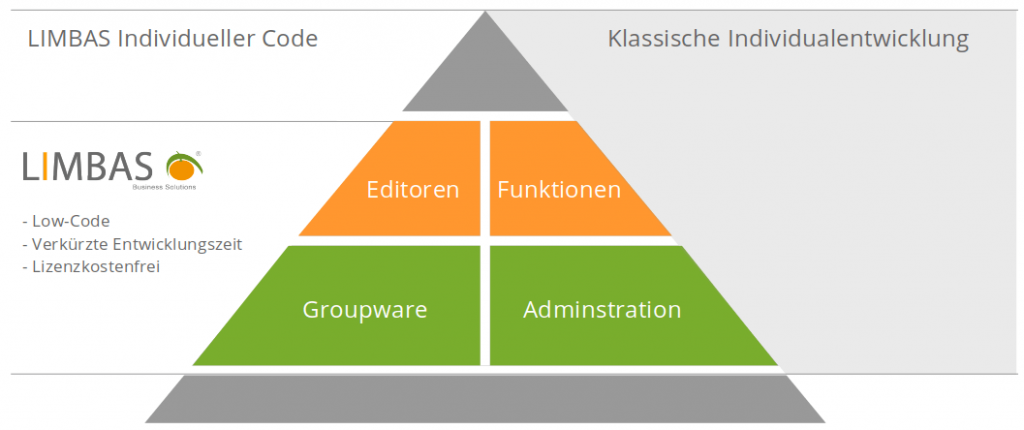
Limbas has a modular architecture. Companies can selectively activate the functionalities that meet their current requirements – from inventory management and financial accounting to production and CRM, all the way to e-commerce.
Tailor-made processes instead of standard software
Thanks to the open source code, business logic, data models, and user interfaces can be individually customized. Specific requirements can be implemented directly in the system – without compromises due to rigid standard processes.
In addition, solutions such as Grafana or MediaWiki offer a proven best-practice software stack that specifically extends Limbas via plugins.
Scalability & technological flexibility
Grow with your company
Open-source business applications are not limited to a specific company size. Limbas is suitable for small and medium-sized enterprises as well as for internationally operating organizations.
Integration skills & openness
Seamless integration of existing systems: Open-source business applications are designed for integration. Limbas supports REST and SOAP web services, among others, and can be easily connected to existing ERP, CRM, or accounting systems.
This openness is particularly advantageous when developing central service or customer portals.
Security & Access Control
Role-based access controls, encrypted data transfers and flexible security policies ensure the protection of sensitive company data.
Security mechanisms are always traceable and verifiable due to the open source code – an often underestimated advantage of open source.
Conclusion: Open Source as the foundation of modern enterprise software
Open-source business applications offer companies a high degree of flexibility, cost-efficiency, and future-proofing. Limbas exemplifies this approach: powerful, scalable, and vendor-independent.
For companies that want to not only digitize their processes but also develop them strategically, Limbas is a compelling and sustainable solution – regardless of size or industry.
Cost-Effectiveness & Manufacturer Independence
No license fees, full control
Open-source software like Limbas is released under the Apache License 2.0 and is completely free to use. This allows companies to avoid high acquisition, user, or maintenance fees, as are common with proprietary ERP systems.
Long-term investment security: Because the source code is open, companies remain independent of individual manufacturers or service providers. They can develop and market their own extensions, products, or services without legal restrictions – a crucial advantage for innovative business models.
Modularity & Individual Adaptability
Only use what is really needed
Limbas has a modular architecture. Companies can selectively activate the functionalities that meet their current requirements – from inventory management and financial accounting to production and CRM, all the way to e-commerce.
Tailor-made processes instead of standard software
Thanks to the open source code, business logic, data models, and user interfaces can be individually customized. Specific requirements can be implemented directly in the system – without compromises due to rigid standard processes.
In addition, solutions such as Grafana or MediaWiki offer a proven best-practice software stack that specifically extends Limbas via plugins.
Scalability & technological flexibility
Grow with your company
Open-source business applications are not limited to a specific company size. Limbas is suitable for small and medium-sized enterprises as well as for internationally operating organizations.
Integration skills & openness
Seamless integration of existing systems: Open-source business applications are designed for integration. Limbas supports REST and SOAP web services, among others, and can be easily connected to existing ERP, CRM, or accounting systems.
This openness is particularly advantageous when developing central service or customer portals.
Security & Access Control
Role-based access controls, encrypted data transfers and flexible security policies ensure the protection of sensitive company data.
Security mechanisms are always traceable and verifiable due to the open source code – an often underestimated advantage of open source.
Conclusion: Open Source as the foundation of modern enterprise software
Open-source business applications offer companies a high degree of flexibility, cost-efficiency, and future-proofing. Limbas exemplifies this approach: powerful, scalable, and vendor-independent.
For companies that want to not only digitize their processes but also develop them strategically, Limbas is a compelling and sustainable solution – regardless of size or industry.